In modern vehicles, the car battery has evolved from a simple starting component into the most powerful and influential system in the entire automobile. While the engine may still provide mechanical motion, the battery now serves as the central nervous system’s power source, supporting dozens—sometimes hundreds—of electronic modules, sensors, computers, and safety systems. As vehicles become increasingly software-driven, a decline in battery performance can dramatically affect not only drivability but also the accuracy of diagnostic systems, often creating misleading or false warnings on the dashboard.
Today’s cars rely on stable voltage to operate critical systems such as engine control modules (ECMs), transmission control units, power steering, braking systems, infotainment, driver-assistance technologies, and emissions controls. Even a minor drop in battery voltage—often unnoticed by the driver—can cause these systems to behave unpredictably. Sensors calibrated to operate within tight voltage ranges may send corrupted data, control modules may fail to communicate properly, and onboard computers may misinterpret electrical irregularities as mechanical failures. This is why a weakening battery can trigger warning lights for systems that are otherwise fully functional, such as traction control, ABS, airbag systems, or even engine fault indicators.
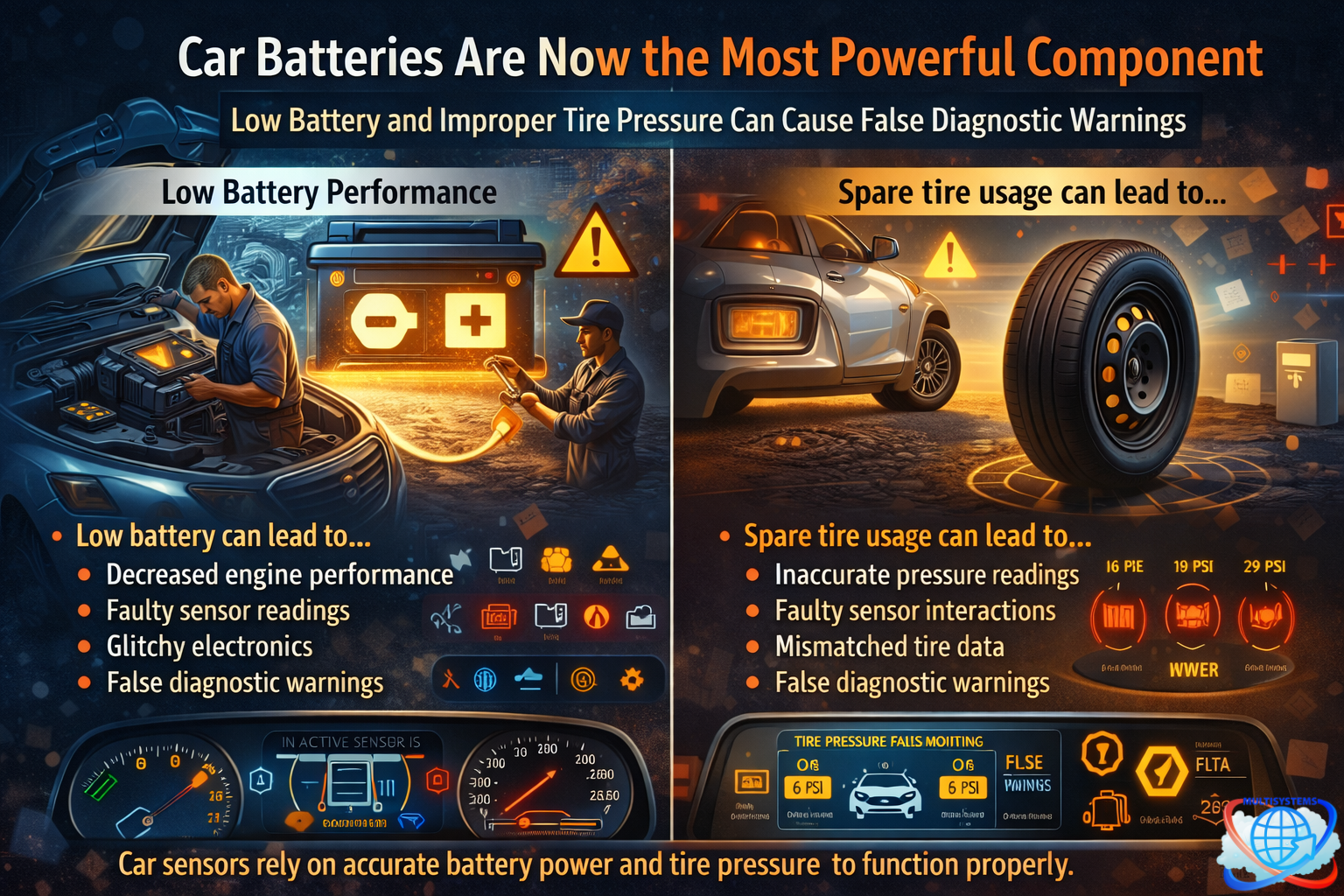
As battery performance declines, the alternator is forced to work harder to compensate, increasing electrical noise and instability across the vehicle’s network. This instability can cascade through the vehicle’s CAN bus (Controller Area Network), leading to false diagnostic trouble codes that confuse both drivers and technicians. In many cases, replacing or recharging the battery resolves multiple “problems” at once—revealing that the issue was electrical rather than mechanical. In essence, the battery now acts as the foundation upon which all vehicle intelligence depends.
Tire pressure plays a similarly critical role in modern vehicles, particularly as sensor density continues to increase. Loss of pressure in one or more tires alters rolling resistance, wheel speed, suspension geometry, and traction characteristics. Modern vehicles continuously monitor these variables using tire pressure monitoring systems (TPMS), wheel speed sensors, yaw sensors, steering angle sensors, and adaptive suspension controls. When tire pressure drops significantly, or when a temporary spare tire is installed, the vehicle’s systems may receive conflicting data.
Temporary spare tires are often smaller, lighter, and designed to rotate at different speeds than standard tires. When driven for extended periods, this mismatch can cause the vehicle’s computer systems to detect irregular wheel speed readings, triggering warnings related to traction control, stability control, drivetrain performance, or braking systems. In some cases, the car may even limit power or disable certain safety features as a protective measure. These responses are not faults in the vehicle but logical reactions to sensor data that no longer aligns with expected parameters.
As vehicles move further into the future—integrating AI-assisted driving, predictive maintenance, and fully autonomous capabilities—the reliance on accurate electrical power and sensor data will only intensify. A weak battery or improper tire configuration will increasingly result in system-level confusion, not because the vehicle is broken, but because its data inputs are compromised.
In today’s and tomorrow’s vehicles, proper battery health and tire condition are no longer basic maintenance concerns—they are core performance requirements. Maintaining a strong battery and correct tire pressure ensures not only smoother operation but also accurate diagnostics, reliable safety systems, and trustworthy vehicle intelligence. In the modern automotive era, power stability and sensor integrity are the keys to keeping the entire machine honest.